
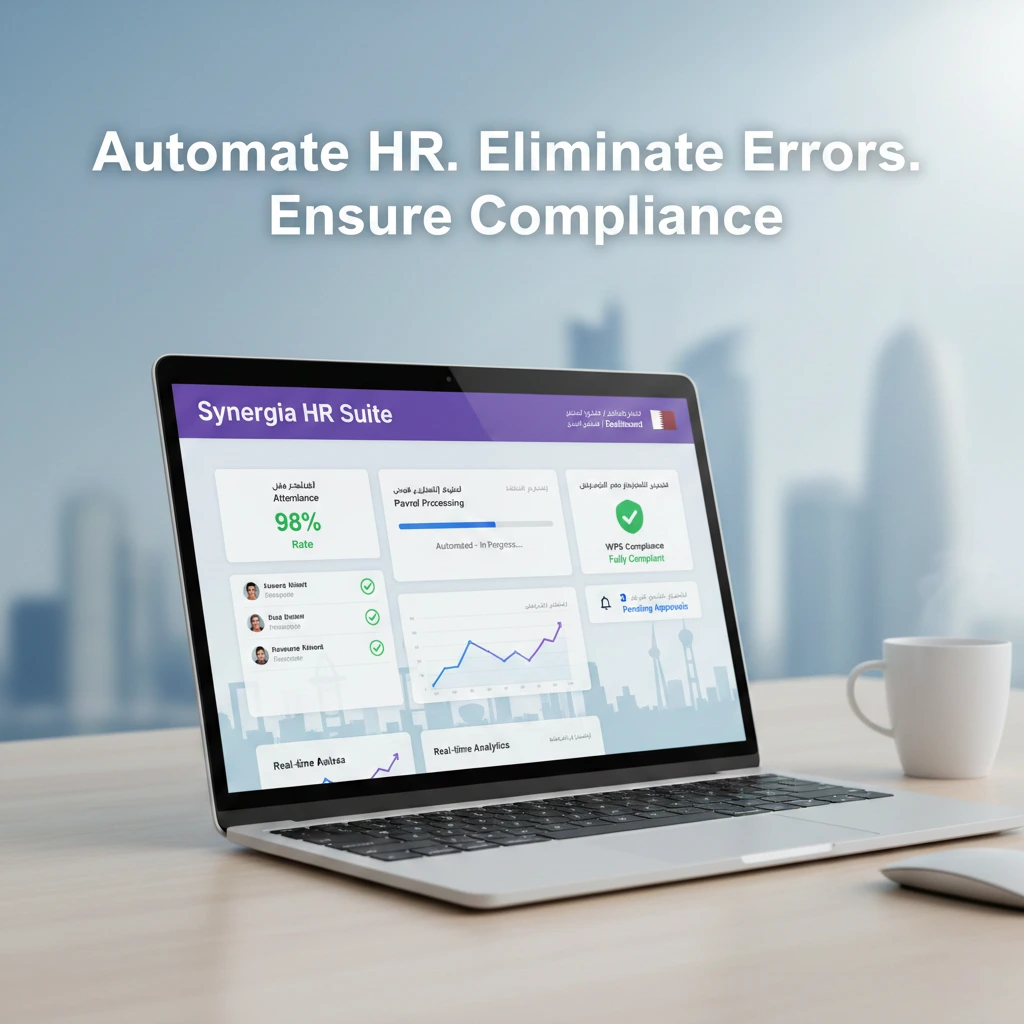
HR Operations Software in Qatar: Reducing Manual Errors and Boosting Efficiency
Managing HR operations manually in Qatar’s fast-paced business environment creates significant challenges for companies. From payroll miscalculations to attendance tracking errors, manual HR processes cost businesses valuable time and resources. HR operations software Qatar offers a practical solution by automating core HR functions, ensuring compliance with Qatar Labour Law, and eliminating costly human errors. Modern businesses in Doha, Al Wakrah, and across Qatar are discovering how cloud-based HR systems transform their workforce management from reactive firefighting to proactive strategic planning.
Key Takeaways
- HR operations software Qatar reduces manual data entry errors by up to 80%, significantly improving payroll accuracy and employee data management
- Cloud-based HR operations management systems ensure automatic WPS compliance and real-time updates to Qatar Labour Law requirements
- Automated attendance tracking, leave management, and approval workflows save HR teams 15-20 hours per week on administrative tasks
- Integrated HR platforms provide centralized employee data, reducing document processing time by 65% while improving accessibility
- Modern HR software delivers measurable ROI through reduced compliance penalties, fewer payroll corrections, and improved operational efficiency
The Cost of Manual HR Operations in Qatar
Understanding Manual HR Challenges
Manual HR operations create a domino effect of problems for Qatari businesses. When HR teams rely on spreadsheets and paper documents, simple tasks become time-consuming processes prone to errors. A McKinsey study found that manual data entry errors cost businesses an average of $5 million annually, with HR departments particularly vulnerable due to the volume of employee data they handle daily.
Qatar businesses face unique challenges including WPS compliance deadlines, frequent visa renewals, and complex labor law requirements. When managing these manually, HR teams spend excessive time on administrative work rather than strategic initiatives that drive business growth.
The Hidden Costs of HR Errors
Manual HR processes generate costly mistakes that impact your bottom line. Payroll errors affect 49% of workers annually according to the American Payroll Association, leading to employee dissatisfaction and potential legal issues. In Qatar, WPS payment delays or miscalculations can result in government penalties ranging from QAR 6,000 to QAR 10,000 per violation.
Beyond financial penalties, manual errors damage employee trust and company reputation. When employees receive incorrect pay or face delays in leave approvals, workplace morale suffers. HR management software addresses these issues by automating calculations and ensuring accuracy across all HR functions.
Time Wastage in Administrative Tasks
HR professionals in Qatar spend approximately 60% of their time on administrative tasks rather than strategic workforce planning. Processing leave requests manually, tracking attendance through paper registers, and updating employee records in multiple systems creates inefficiency. A Deloitte report indicates that companies using manual HR processes take 18 times longer to complete routine tasks compared to those using automated systems.
Consider a typical month-end payroll cycle: manually calculating salaries, allowances, deductions, and overtime for 100 employees can take 40-50 hours. This doesn’t include time spent verifying data accuracy or correcting errors discovered after processing.
How HR Operations Software Eliminates Manual Errors
Automated Data Entry and Validation
Cloud-based HR software eliminates manual data entry errors through intelligent automation and validation rules. When employees update their information through self-service portals, the system automatically validates data formats, checks for duplicates, and flags inconsistencies before saving. This real-time validation prevents incorrect phone numbers, invalid passport details, or duplicate employee IDs from entering your database.
Advanced employee management systems include built-in checks for Qatar-specific requirements like QID number formats and visa expiry dates. The software cross-references entered data against existing records, ensuring consistency across all modules from payroll to attendance tracking.
Integrated Payroll Processing
Payroll automation through HR operations management system ensures mathematical accuracy and compliance with Qatar’s wage protection requirements. The software automatically calculates basic salary, housing allowances, transportation benefits, overtime pay, and statutory deductions based on predefined rules. This eliminates calculation errors that commonly occur in manual spreadsheet-based payroll.
Integration with attendance systems means hours worked, overtime, and absences flow directly into payroll calculations without manual data transfer. Payroll management software also handles complex scenarios like mid-month salary adjustments, bonus calculations, and end-of-service benefit computations with complete accuracy.
Real-Time Compliance Monitoring
Qatar’s regulatory environment requires constant attention to WPS deadlines, visa renewals, and labor law updates. Modern HR operations software includes automated compliance monitoring that tracks all regulatory requirements and alerts HR teams before deadlines. The system automatically formats payroll data according to WPS management standards, eliminating the manual work of preparing compliant salary transfer files.
Document expiry tracking ensures you never miss critical renewal dates for work permits, health cards, or professional licenses. According to Gartner, automated compliance monitoring reduces regulatory violations by 73% compared to manual tracking methods.
Key Features That Boost Operational Efficiency
Centralized Employee Database
A unified employee database serves as the foundation for efficient HR operations. HR operations software Qatar consolidates all employee information—personal details, employment history, compensation data, documents, and performance records—into a single accessible platform. This centralization eliminates the need to search through multiple spreadsheets or file cabinets when you need employee information.
When employee data updates in one module, it automatically reflects across all connected systems. If an employee receives a promotion and salary increase, this change instantly updates in payroll, the organizational chart, and access permissions without requiring manual updates in multiple locations.
Automated Attendance and Leave Management
Biometric integration and mobile check-in systems revolutionize how Qatar businesses track employee attendance. Employee attendance software automatically records clock-in and clock-out times, calculates working hours, identifies overtime, and flags attendance violations—all without manual intervention.
Leave management automation streamlines the entire process from request submission to approval and payroll adjustment. Employees submit leave requests through their mobile devices, managers receive instant notifications, and approved leave automatically updates attendance records and reduces available leave balances. This workflow reduces leave processing time from days to minutes while maintaining complete audit trails.
Workflow Automation and Approvals
Modern HR platforms transform manual approval chains into automated digital workflows. Whether processing leave requests, expense claims, or promotion recommendations, automated approval systems route requests to appropriate stakeholders based on predefined rules, track approval status in real-time, and send automated reminders for pending actions.
Multi-level approval workflows ensure proper authorization while maintaining process speed. If a primary approver is unavailable, the system automatically escalates to designated alternates, preventing bottlenecks that plague manual processes.
Employee Self-Service Capabilities
Employee self-service portals reduce HR workload by empowering staff to manage their own information and requests. Through secure portals, employees can view payslips, update personal details, check leave balances, submit time-off requests, and access company policies without contacting HR. This self-sufficiency reduces HR inquiry volume by approximately 40% according to industry research.
For HR teams, self-service means fewer interruptions and more time for strategic initiatives. Employee self-service portals also improve employee satisfaction by providing 24/7 access to personal HR information and reducing wait times for routine requests.
Implementing Cloud-Based HR Solutions in Qatar
Advantages of Cloud Technology
Cloud-based HR software offers Qatar businesses significant advantages over traditional on-premise systems. Cloud solutions require minimal IT infrastructure, eliminate expensive server maintenance, and provide automatic software updates that keep your system current with the latest features and compliance requirements. Companies can deploy cloud HR systems in weeks rather than months, starting operations quickly without lengthy implementation projects.
Scalability represents another crucial benefit—as your business grows, cloud platforms easily accommodate additional users and expanded functionality without requiring hardware upgrades. IBM research indicates that cloud-based HR systems reduce IT costs by 40% while improving system reliability and uptime.
Security and Data Protection
Data security concerns often arise when discussing cloud solutions, but modern cloud HR platforms provide enterprise-grade security that exceeds most companies’ internal capabilities. Leading providers implement bank-level encryption, multi-factor authentication, regular security audits, and compliance with international data protection standards including GDPR.
For Qatar businesses, reputable HR software vendors maintain data centers with redundant systems, automated backups, and disaster recovery protocols that ensure business continuity. Access controls and audit logs track every system interaction, providing complete transparency and accountability for sensitive employee data.
Integration with Existing Systems
Successful HR operations software implementation requires seamless integration with your existing business systems. Modern platforms offer APIs and pre-built connectors for accounting software, time tracking devices, biometric systems, and other business applications. This integration eliminates data silos and ensures information flows smoothly across your entire business technology ecosystem.
The integration capability extends to government systems like WPS portals, enabling direct salary file submission without manual exports and uploads. When selecting an HR operations management system, prioritize platforms with proven integration capabilities relevant to Qatar’s business environment.
Measuring ROI and Success Metrics
Quantifiable Efficiency Improvements
Measuring the impact of HR operations software requires tracking specific metrics before and after implementation. Key performance indicators include time spent on payroll processing, error rates in employee data, compliance violation frequency, and average time to complete HR requests. Companies typically observe 60-80% reduction in time spent on administrative tasks within the first six months of implementation.
Calculate direct cost savings from reduced overtime for HR staff, fewer compliance penalties, and decreased error correction costs. A mid-sized Qatar company with 200 employees can save QAR 120,000-180,000 annually through payroll error elimination and compliance automation alone.
Employee Satisfaction and Engagement
Beyond operational metrics, HR software implementation impacts employee satisfaction measurably. Track metrics like employee portal usage rates, average time to resolve HR queries, and employee satisfaction scores regarding HR service quality. Research by PwC shows that companies with effective self-service HR systems experience 14% higher employee engagement scores.
Regular employee feedback surveys should assess satisfaction with HR processes, accessibility of information, and overall experience with the new system. Improved employee experience translates directly to better retention rates and productivity levels.
Strategic HR Impact
The most significant ROI comes from transforming HR from an administrative function to a strategic business partner. As automation handles routine tasks, HR professionals gain time for workforce planning, talent development, and organizational improvement initiatives. Track the percentage of HR time spent on strategic activities versus administrative tasks as a key indicator of successful transformation.
Organizations that effectively leverage HR operations software Qatar report improved decision-making through real-time workforce analytics, better succession planning through comprehensive talent data, and enhanced ability to respond to business changes quickly.
Conclusion
HR operations software Qatar represents a strategic investment that delivers measurable returns through error reduction, compliance assurance, and operational efficiency. As Qatar’s business landscape evolves, manual HR processes become increasingly untenable—creating risks, wasting resources, and preventing HR teams from contributing strategically to business success. Modern cloud-based HR operations management systems eliminate these challenges while positioning your organization for sustainable growth.
The transformation from manual to automated HR operations isn’t just about technology adoption; it’s about empowering your workforce, protecting your business from compliance risks, and creating a foundation for data-driven decision-making. Qatar businesses that embrace comprehensive HR automation today build competitive advantages that compound over time through improved efficiency, reduced costs, and enhanced employee experiences.
Ready to eliminate manual HR errors and transform your workforce management? Contact Synergia HRMS to discover how our Qatar-focused HR operations software can streamline your processes and drive measurable business results.
FAQ
1. What is HR operations software?
HR operations software is a comprehensive digital platform that automates and manages core human resource functions including employee data management, payroll processing, attendance tracking, leave administration, and compliance monitoring. It eliminates manual paperwork by centralizing all HR processes in one integrated cloud-based system, improving accuracy and operational efficiency for businesses.
2. How does HR operations software reduce manual errors in Qatar businesses?
HR operations software reduces manual errors through automated data validation, built-in calculation engines, and real-time data synchronization across all modules. The system validates employee information against Qatar-specific requirements like QID formats, automatically calculates payroll with zero mathematical errors, and eliminates duplicate data entry by integrating attendance tracking directly with payroll processing modules.
3. Is HR operations software compliant with Qatar Labour Law?
Yes, modern HR operations software designed for Qatar includes built-in compliance features aligned with Qatar Labour Law and WPS requirements. The system automatically formats salary files according to WPS standards, tracks visa and document expiry dates, calculates end-of-service benefits correctly, and updates automatically when regulations change, ensuring continuous compliance without manual monitoring effort.
4. What are the main features of cloud-based HR software?
Cloud-based HR software offers centralized employee databases, automated payroll processing, biometric attendance integration, digital leave management, document renewal tracking, workflow approvals, employee self-service portals, real-time reporting dashboards, and mobile accessibility. These features work together seamlessly, eliminating data silos and enabling HR teams to manage entire workforce operations from anywhere with internet access.
5. How long does it take to implement HR operations software?
Implementation timelines for HR operations software typically range from 2-6 weeks depending on company size and complexity. The process includes data migration from existing systems, user training, system configuration for Qatar-specific requirements, integration with biometric devices, and testing. Cloud-based solutions implement faster than on-premise systems, with minimal IT infrastructure requirements for Qatar businesses.
6. Can small businesses in Qatar benefit from HR operations software?
Absolutely, small businesses gain significant advantages from HR operations software by automating time-consuming administrative tasks that would otherwise require dedicated HR staff. The system handles payroll calculations, tracks employee attendance, manages leave requests, and ensures WPS compliance automatically. This allows small business owners to focus on growth while maintaining professional-grade HR operations with minimal overhead.
7. What is the cost of HR operations software in Qatar?
HR operations software costs in Qatar vary based on employee count, required features, and deployment model. Cloud-based solutions typically operate on monthly or annual subscription models ranging from QAR 15-50 per employee monthly. This pricing usually includes software updates, technical support, data security, and regular compliance updates, making it more cost-effective than maintaining manual HR processes or on-premise systems.
8. Does HR operations software integrate with existing accounting systems?
Yes, modern HR operations software provides API connections and pre-built integrations with popular accounting systems, time tracking devices, and biometric attendance systems. This integration ensures payroll data flows automatically to your accounting software, eliminating manual data transfer and reducing month-end closing time. The compensation management module syncs seamlessly with financial systems for accurate reporting.
9. How does automated attendance tracking work in HR software?
Automated attendance tracking captures employee clock-in and clock-out times through biometric devices, mobile apps, or web-based systems. The data flows directly into the HR platform, automatically calculating working hours, overtime, late arrivals, and absences. The system applies your company’s shift rules and policies automatically, updating attendance records in real-time without manual register maintenance or data entry.
10. What security measures protect employee data in cloud HR software?
Cloud HR software employs bank-level encryption for data transmission and storage, multi-factor authentication for user access, role-based permissions limiting data visibility, regular automated backups, and compliance with international data protection standards. Leading providers maintain ISO-certified data centers with 24/7 monitoring, ensuring employee data remains secure and accessible only to authorized personnel within your organization.


